Heat exhaustion and dehydration can be detrimental to our pets’ health and is a condition that becomes more common through summer, especially when the humidity is high.
Understanding some simple ways to keep your pet cool through the hotter days can be an easy way to avoid dehydration.
PetSafe® Australia has shared their 8 simple tips to keep your pet cool and hydrated this season as part of their annual Pet Hydration Month campaign.
#1. More Water, More Often
Animals need more water than humans. Dogs for example are made up of 80% water where humans are only 60%. Therefore, in the heat of summer, your dog requires more water, more often.
A general rule of thumb is that a dog needs 70mls of water per kilogram of body weight, so a 4.5kg dog needs 2 bowls a day, and a 35kg dog needs 10!
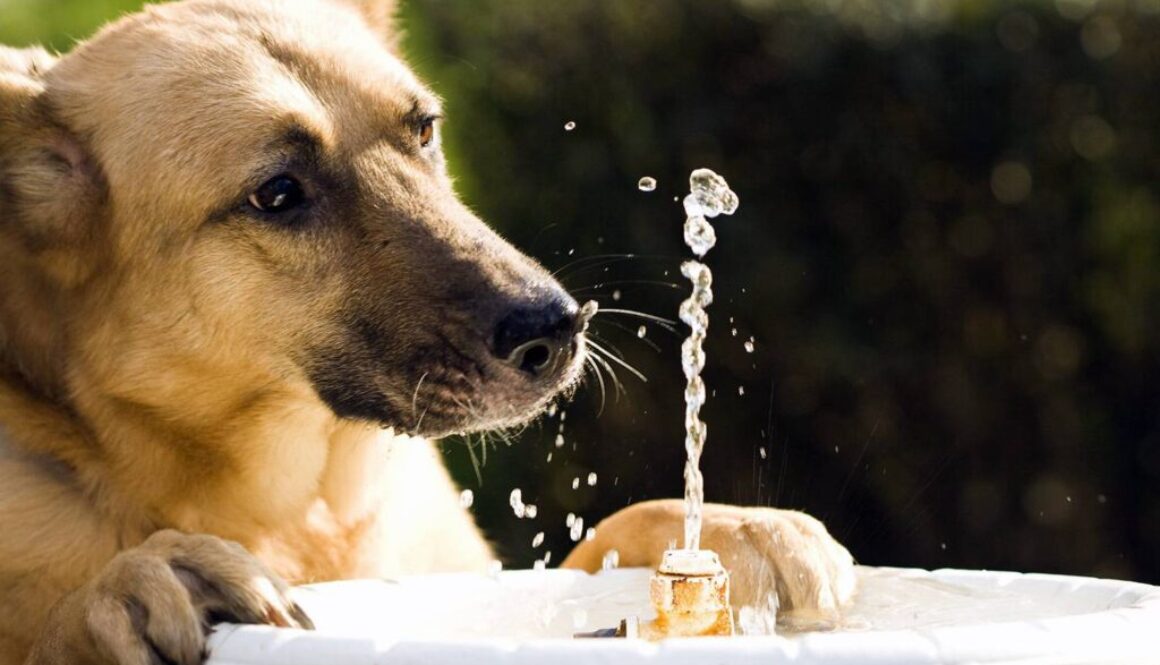
The easiest way to encourage your pet to constantly rehydrate is with a pet drinking fountain.
These provide fresh, filtered water to your pet and the multiple streams of free falling water entice your pet to drink more.
#2. Provide Shade – All Day
Most dog owners are not home for most of the day, with pets being left alone sometimes up to 10 hours. The backyard is the most common area that dogs will be, and most people don’t realise that this can also be the most hazardous.
Make sure you provide your pet with adequate shade that will last all day. This can be easily achieved by investing in a shade cloth, large outdoor umbrella or canopy, or a kennel. But remember not all dog houses are ‘heat proof’ so make sure you give them an all-day shady option.
#3. Keep That Hair Short
Just like you would prepare your home for bush fire season, you need to prepare your pet for summer! The shorter the hair, the cooler they will stay so if you have a dog with a long or shaggy coat give it a nice short shave. This will keep them cool.
However not all dogs should be shaved. In particular, dogs with a double coat should not be shaved – e.g. the Samoyed, Husky, Border Collie and German Shepherd breeds. In fact, you should avoid shaving any dog (regardless of breed) that has an undercoat. Shorthaired dogs should also avoid being shaved. These dogs only have a single layer of fur, so shaving it off increases the risk of sunburns.
#4. Exercise at Dawn or Dusk
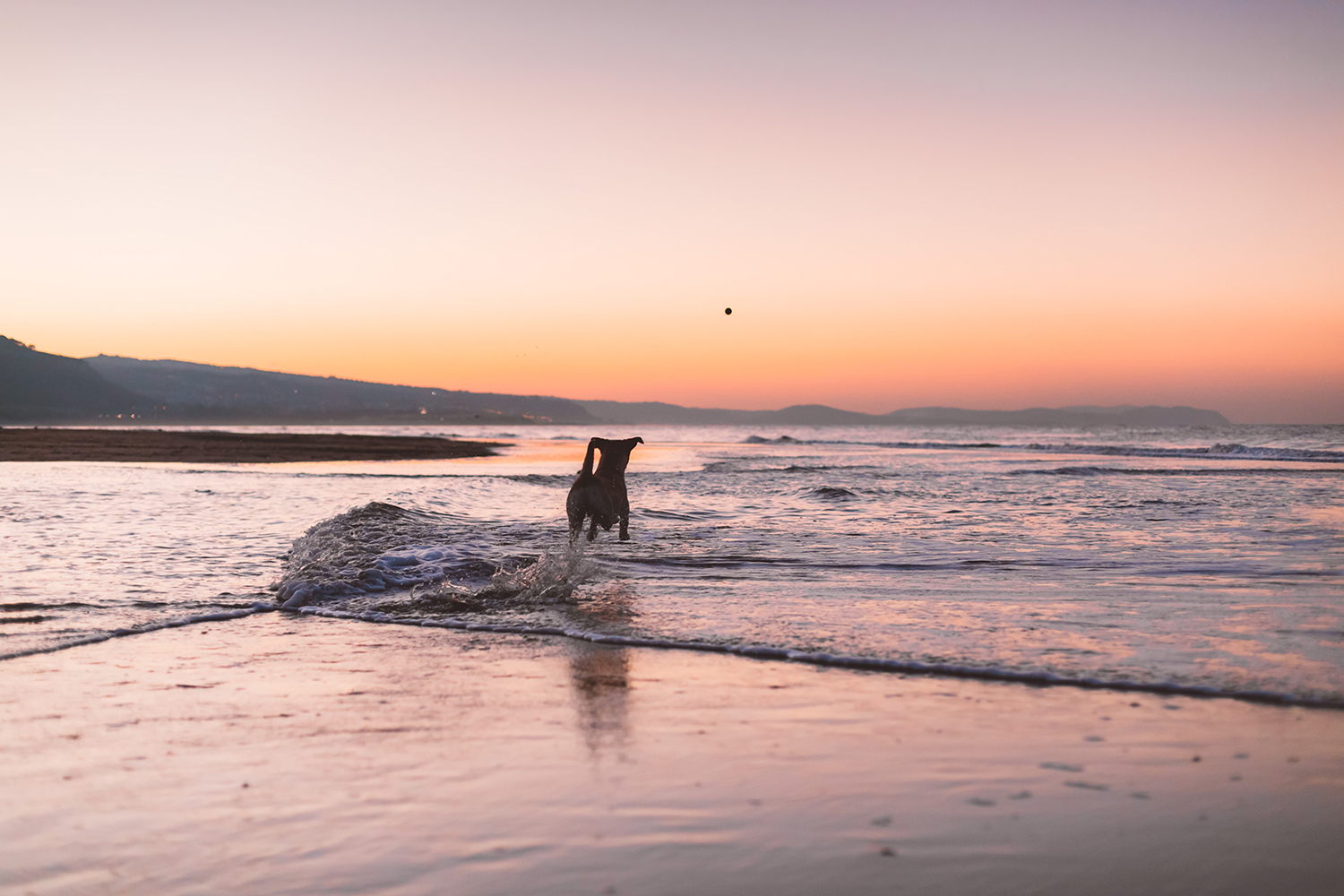
All pets need some exercise; however if you take them out for walks in the summer time change your routine to dawn or dusk walks.
This makes it cooler for you and your pet and is also less harsh on their paws. They can feel the heat of the sand or bitumen just like you!
#5. Let Them Dig
Believe it or not… dogs don’t just dig out of boredom. It can be to hide food or toys but also to keep cool! Just remember, a little bit of digging won’t hurt.
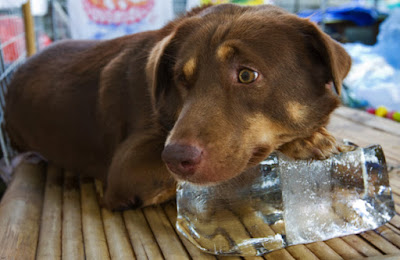
#6. Freeze some doggie icy poles
Dogs love a frozen treat in the summer and it cools them down.
Pet icy poles are easy to make and can keep them busy. Just add their favourite treats to water and freeze! Easy!
#7. Give them a Bath
Shallow pools are a great way for your pet to cool down! Or buy a child’s sand pit / clam shell and fill it with shallow water and watch them splash! Just ensure that you keep an eye on your pets whilst they use the pool.
#8. Never Chain them Up
Some people will tie up their dogs in the backyard when they head out for the day! However. this can prevent them from finding cool shade or respite from the heat of the day.
If you don’t have adequate fencing you could invest in a pet containment system or corner off a smaller section of the yard that has plenty of shade and water!
Dehydration in pets can be very serious and even deadly in some cases, being aware of your pets’ hydration needs could be the difference between life and death for our pets over the summer.
Oatmeal Baths – A common cause of hot spots is itching caused by allergies. Soothing itching can be a tough battle, and oftentimes it includes long-term steroid use. While this certainly has it benefits, it has its risks as well. However, a simple, homemade oatmeal bath for your dogs should help soothe their discomfort. By adding a few large handfuls of rolled oats to some hot water, and once it’s cooled down, you have an easily made oatmeal shampoo to soak your pup in. Remember that too many baths can be detrimental to your dogs, especially if they have allergies; so make sure to keep this spa treatment a once-a-month thing
Green Beans – Obesity is a quickly growing problem for many dogs around the world. While being a pound or two overweight might not be a big deal for you, it’s a big deal for your dog. Just like in people, obesity is an ambassador for health problems galore – it puts a huge strain on the dog’s entire body. Obese pets are more prone to disc and joint disease and injuries, muscle injuries, pancreatitis, diabetes, heart disease, and cancer. We know it’s hard to look Bella in the eyes when you give her only two-thirds of her normal food ratio. We’re afraid she’s going to be left hungry, like so many of us are on our own diets. But steamed green beans are a new lifesaver. Just remember to add the same amount of green beans to make up for the missing portion of food you’ve cut out in your dog’s meal. Green beans are full of fiber, so your pup will be left feeling very satisfied, while eating far less calories.
Canned Pumpkin – Diarrhea and constipation are common in ailments in dogs at least once in a while. Although sometimes it can be the result of a more dangerous illness, it’s often just an upset tummy from somebody who ate something they shouldn’t have. Canned pumpkin (or a homemade pumpkin puree), however, can offer a solution to both! Canned pumpkin is extremely rich in dietary fiber and not only aids in digestion, it will soak up the excess water present in your dog’s bowels if he’s got diarrhea. Give 1-2 teaspoons to 1-2 tablespoons with your dog’s meal depending on his or her size. Remember, we want plain canned pumpkin – do NOT give your dog canned pumpkin pie mix, as it’s loaded with sugars and other ingredients that will only exacerbate Fido’s problems, and possibly cause more.
Benadryl – Dogs are curious, so they get into a lot of things. Sometimes those things (like eating bees, for example) can cause allergic reactions. Benadryl (diphenhydramine) can be administered at 2mg/lb of body weight. It can be used for any allergies, such as itchy skin, rashes, and hot spots, but it’s important to keep this in mind if you see any abnormal swelling you think may be due to an allergic reaction. While you can administer Benadryl yourself, it’s important to remember that you should seek veterinary care if your dog experiences any type of allergic reaction.
Black Tea – Hot spots are a very common problem for many dogs and their owners. They seemingly come out of nowhere and are very uncomfortable for everyone involved, especially our pups. Major hot spots need veterinary treatment, but if you find one starting early or have a smaller hot spot that isn’t so severe, consider foraging through your tea stash. Black tea leaves, when steeped in hot water, contain tannic acid that naturally helps dry out and heal the sores quickly. You’ll apply the tea bag directly to the hot spot (be careful the bag isn’t too hot!) and soak for about 5 minutes. You can do this three to five times a day, as needed.
Here in Australia we love our summers. Hot sunny days, beaches and barbeques are part of our identity. As we all know from a day spent too long in the sun, it’s definitely possible to have too much of a good thing. This applies to our pets too, and the most devastating consequence of warm weather is heat stroke.
Although vets can treat affected pets if they’re seen early enough, dogs sadly die from heat stroke every summer. The simple summary below will help you keep your fur kids comfortable, safe and chilled out when the mercury rises.
What is Heat Stroke?
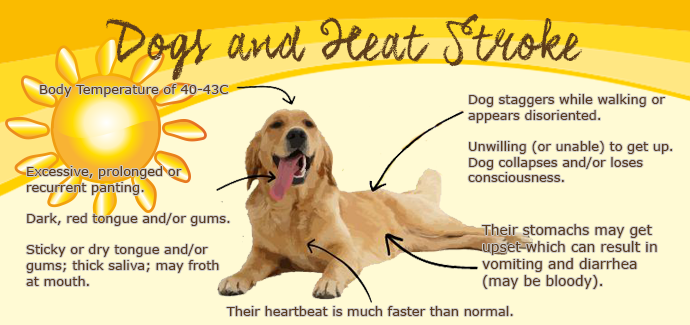
A dog’s normal core body temperature sits around 38.5°C. Heat stroke, or hyperthermia, is defined as asevere increase in body temperature up to 40.5°C – 43°C caused by elevated ambient temperatures and/or strenuous activity.
Dogs can’t sweat to cool themselves like us, and as their body gets hotter, a dog’s normal adaptive cooling mechanisms like panting and increased blood flow to the skin stop working.
Blood pressure drops and along with it so does the blood supply to vital organs. This can result in widespread organ damage, severe illness and even death.
Which Dogs are Most Affected by the Heat?
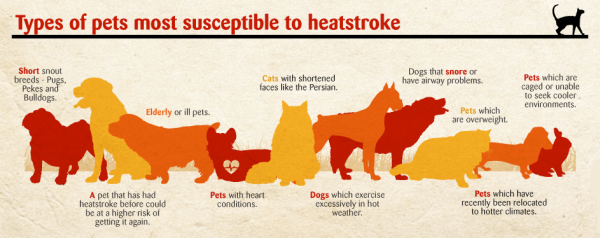
Any dog can overheat, but some are more susceptible than others.
Seniors and the very overweight have more difficulty regulating their body temperature than healthy adult dogs.
Those that are unwell are easily affected, particularly if they have a problem such as vomiting, diarrhoea or kidney disease that leads to dehydration. Dogs with very thick warm coats who were bred to live in colder climates may struggle, and a summer haircut may be in order.
The most common group of dogs seen by vets for heat stroke are those known as brachycephalic breeds. These are the dogs with shorter snouts, such as Pugs and Bulldogs (e.g. the popular Frenchies). These guys are very cute, but they have significant problems with their airways and overheat very quickly. It’s vitally important to keep these dogs cool on hot days.
What are the Signs of Heat Stroke?
Signs may vary between animals, but they commonly include:
✔️ Incessant panting (increases as heat stroke progresses)
✔️ Drooling, salivating
✔️ Agitation, restlessness
✔️ Very red or pale gums
✔️ Bright red tongue
✔️ Increased heart rate
✔️ Breathing distress
✔️ Vomiting, Diarrhoea (possibly with blood)
✔️ Signs of mental confusion, delirium
✔️ Dizziness, staggering
✔️ Lethargy, weakness
✔️ Muscle tremors
✔️ Seizures
✔️ Collapsing and lying down
✔️ Little to no urine production
✔️ Coma
How to Avoid Heat Stroke
Tip #1. Keep dogs indoors with air-conditioning on and fresh drinking water during very hot days.
Tip #2. For those outdoors, ensure adequate access to a shady, well-ventilated area all day and that there is plenty of cool, clean drinking water available. Provide multiple sources in case a bowl gets knocked over.
Tip #3. Avoid exercise during the day. Not only are dogs likely to overheat if exercised during the hottest part of the day, but surfaces will be hot enough to burn paws. Early morning or late evening walks when the weather is cool are best.
Tip #4. Many dogs will love a ‘clam shell’ pool filled with water. They can hop in for a splash and have an extra source of drinking water that is unlikely to spill or run out.
Tip #5. Keep coats well-groomed and short. Long matted fur is not only uncomfortable but will trap heat making it harder to cool down.
Tip #6. Frozen treats, prepared the night before, are great for dogs. Throwing a few ice cubes into drinking water will also help to keep it cool and refreshing.
Tip #7. Very importantly, NEVER, EVER leave your pet alone in a parked car. Even if it’s ‘not that hot’ outside, and even if the windows are down, it can still easily get hot enough to endanger life.
The RSPCA reminds us that it can take just six minutes for a dog to die of heatstroke when left in a car.
How to Help a Dog Experiencing Heat Stroke
If you think your dog has heat stroke, you need to get to a vet as soon as possible. Even if they appear to recover, there may be internal damage that takes days to become obvious.
There are some immediate steps you can take at home to help.
1. First of all, remove the heat source if possible. If out in the sun, get them inside, in the shade and/or air conditioning.
2. The next thing we want to do is cool them down.
There are a number of ways to achieve this:
You can pour cool water over them
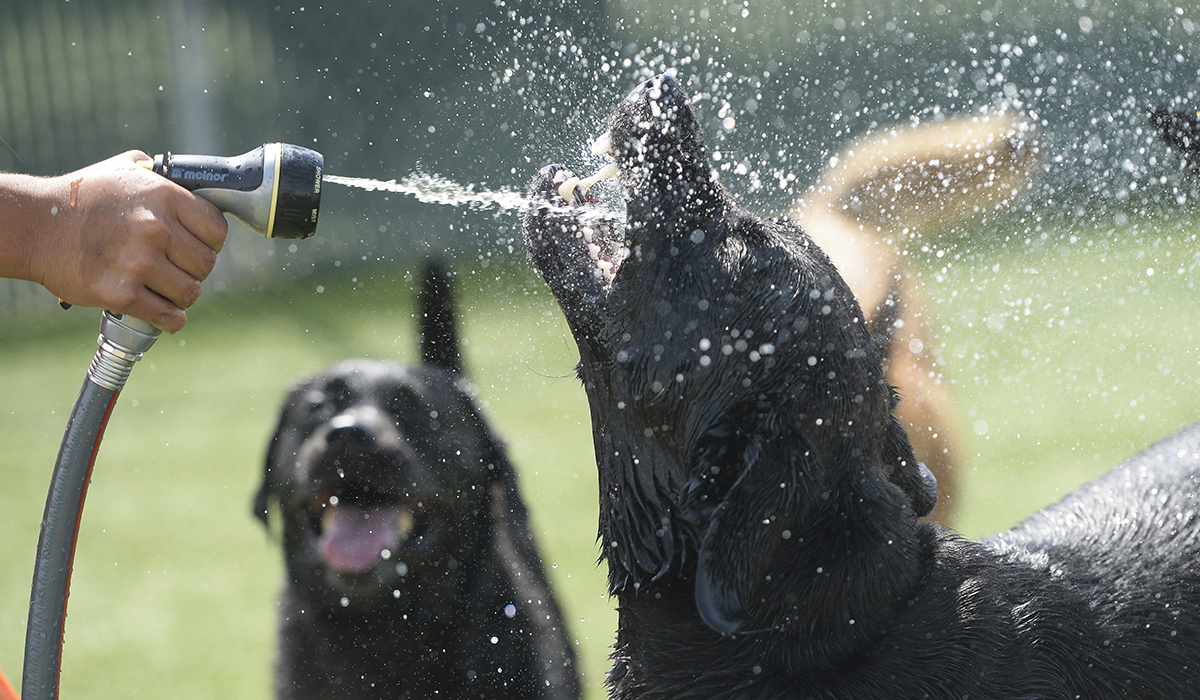
Spray them (gently) with a garden hose
Immerse them in cool water (but not if they are collapsed or struggling to breathe) or
Drape them with wet towels
Using a fan to help dissipate heat by convection can also be beneficial.
With any method of cooling, use tepid or cool water, but NOT ice or iced water. Extreme cold can cause the blood vessels in the skin to react by constricting, and this will cause core body temperature to rise even further.
Ideally check your dog’s temperature every 10 – 15 minutes.
3. If the temperature has dropped below 39.5°C,stop cooling them immediately. From there on, their temperature can drop rapidly and we don’t want it to go too low.
Offer a drink of water but please don’t force them to drink.
4. If your dog is too severely affected to attempt cooling at home, for example if he is collapsed or having seizures, throw a wet towel over him, get him into the car, crank up the air con and drive straight to your nearest vet.
Please Note: even if you think you have averted a crisis and your dog appears to be fine you should still see your vet. Despite looking good on the outside, life-threatening complications such as blood clotting problems, organ damage or brain swelling may be quietly brewing.
Dr Joanna Paul from Creature Clinic is a Melbourne-based veterinarian who has been working in partnership with pet parents to care for their furry kids for over a decade.
As well as work, she divides her time between her gorgeous dog Billy, a menagerie of other fur kids and three children.
What to change in your home life to decrease your dog’s overall stress level
Owning a reactive dog is a challenge that makes life tricky in many ways. You might have to prepare every walk in detail (where to go – how many other dogs and people to expect – where to escape if your dog crosses his threshold), have a meticulous plan in place if you need to leave your dog with a sitter or put your dog in a room at the other end of the house every time company comes over.
The stress of the dog pairs with the stress of his owner, and together you can quickly get into a spiral of being anxious and somewhat on edge most of the time.
While no dog trainer has a magic approach that will make your dog’s reactivity disappear, there are a number of small but impactful changes you can implement in your daily life to lower your dog’s general stress level. Reactivity is very much enhanced by existing stress, so making a deliberate attempt every day to reduce your dog’s stress will be very helpful.
A Holiday from Stress
In reactive dogs, we should strive to give them a holiday from stress as much as possible. Of course, in many cases we cannot prevent them from encountering their triggers every now and then.
However, dogs actually “put up” with a lot of small stressors every day that we might chalk up to normal life.
Think about your dog’s day-to-day behaviour:
Is there anything happening around the house that irritates him? Is there an easy solution to avoid these situations?
I, for example recently had a client whose reactive dog was really triggered by construction vehicles that drove by the house every morning at 8am. He started his day already jacked up on adrenaline from this morning stress, and every encounter with triggers later in the day was made worse by it.
For him, we made sure that she put him into the room furthest away from the road well before 8am with something to chew. This small change completely took care of the “morning truck tantrum” and made the dog’s rest of the day much more relaxed.
Chewing
Chewing is a vastly underappreciated activity for adult dogs. While every dog owner realizes that puppies need to chew a lot, we tend to not be as mindful when it comes to providing ample chewing opportunities to grown-up dogs.
Chewing (and licking as well) are very calming activities for dogs. In fact, we often see reactive and stressed dogs attempt to self-soothe by licking their toes, chewing on their feet or even giving themselves hotspots as they nibble away at their skin.
I recommend that every dog that struggles with reactivity and anxiety chews for at least one hour every day, better two or more. If you try this, you will usually see a change in your dog’s overall demeanour within a week.
Perfect chew items are hollow rubber toys such as from the Kong brand or similar. You can fill them with any kind of puree (you can use soaked kibble, raw food, pureed pumpkin, yoghurt …) and freeze them.
That way you have a refillable, affordable chew option always available for your dog.
In addition to providing these every day, it can be useful to give these to your reactive dog after he has experienced a triggering episode to help him calm down.
Scatter-Feeding
Scatter-feeding is a highly effective way to calm dogs down and provide them with low-key mental exercise.
Sniffing itself is very relaxing for dogs – just a few minutes of sniffing can lower your dog’s heart rate by 5-10 bpm!
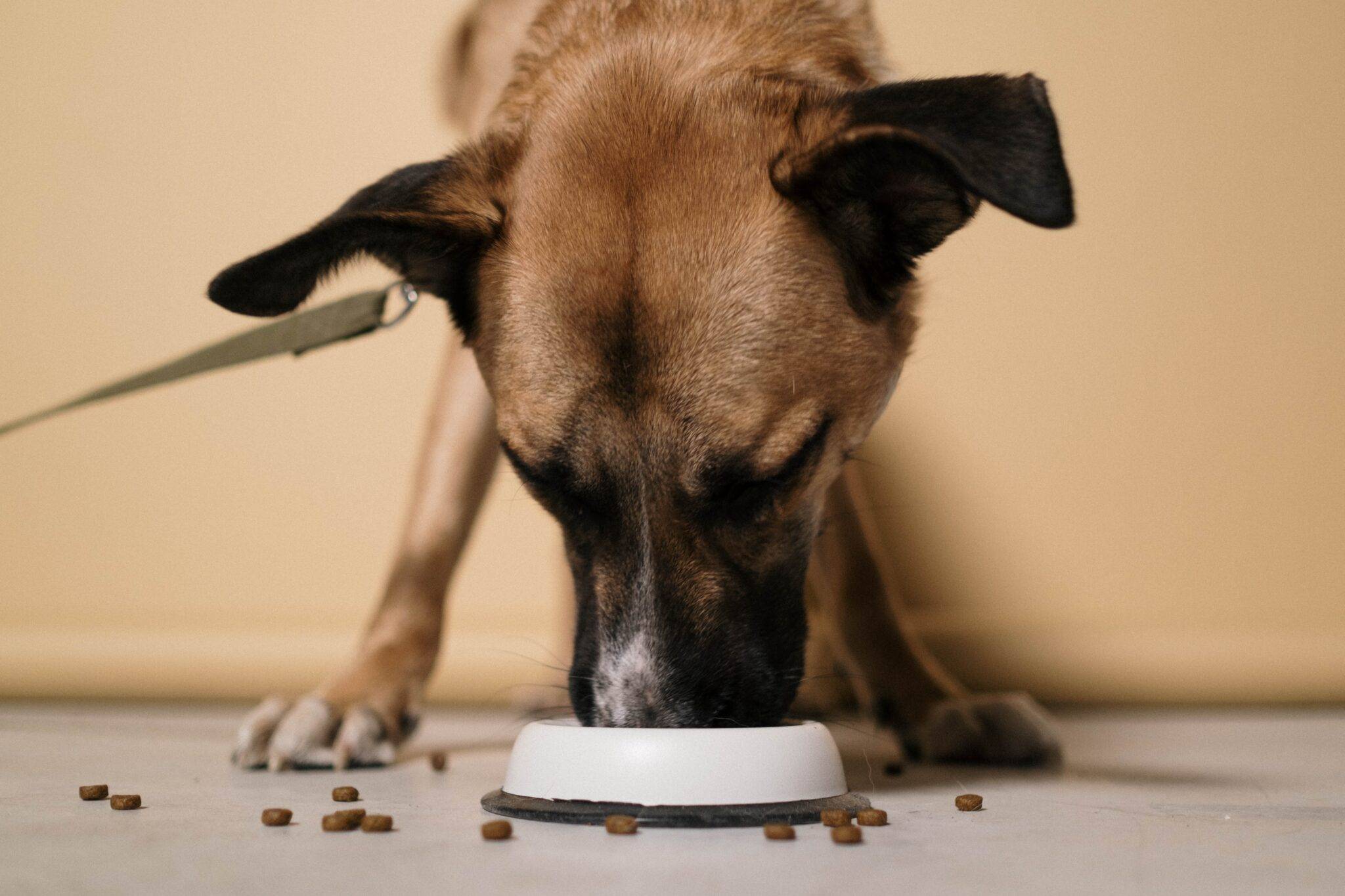
We can make our dogs sniff by scattering their food instead of giving it to them in a bowl. When you scatter your dog’s food, make sure to actually cover a rather large surface with it. The most common mistake I see in owners who try this is that they put all the food into one place. Spread it out! You can pretend that you are putting out wildflower seeds.
The more ground you cover, the more your dog will need to use his nose to search for the food, and the more he sniffs, the calmer he will get.
Nosework actually is a quite tiring activity for dogs, and this will not only relax your dog but also tire him out without the “high” dogs get from physically challenging exercise (such as playing fetch).
Schedule Naps
Dogs that are always a bit on edge and anxious tend to not take regular naps. As carnivores, they are not made to stay awake for hours on end.
Aramis is usually “go-go-go” but also enjoys taking long naps!
Most dogs do best if they are awake for about 3 hours and then take a nap. If your dog is always on the move, he will get more cranky and easily irritated as the day goes on.
Some dogs do not know when it’s time to relax and are not good at settling down by themselves.
If you have a dog that likes to go-go-go, make sure that you give him quiet times for napping.
This might mean having him in one room, an exercise pen or his crate for the nap. Dogs that are allowed to go in and out at their choosing should be kept inside when it is time to nap – being outside all day can be so stimulating that they are unable to settle down.
Quality Time
When you have a reactive dog, it is easy to see the dog and any interaction as always connected to the reactivity. It is extra important to make time for you to simply enjoy your dog and his company, without worrying about his difficulties. Find routines that you both enjoy and strengthen your bond.
Maybe this is playing frisbee in the yard, teaching your dog manner and tricks. Maybe it is brushing or massaging your dog at night while you watch TV. Maybe it is challenging him with food puzzles and watching him work his brain.
The exact kind of activity does not really matter – it is only important that you get to connect and enjoy each other’s presence.
A Trusted Dog Sitter
Having a reactive dog can mean stressing out over any situation in which your dog might need to be without you. I highly recommend to try and introduce someone you trust to your dog who can take over if needed.
Even if it takes a few weeks or months to make sure that your dog is comfortable with this new person, the time you invest into this now will pay off very much in the future. Whether you might have a work, health or family emergency or you simply want to take a trip for a few days – not having to worry that your reactive dog only feels safe with you will be a huge relief.
Once you have a trusted sitter, you can also use the help of them if you ever feel like you need a break from the stress and reactivity. If you are less stressed, your dog will be as well!
Find Safe Zones
Bush trails are Porthos’ happy place!
Walking your reactive dog can be a struggle if you are constantly looking out for potential triggers and preparing yourself to calm down your dog in case he crosses his threshold.
The good news is that chances are there are safe zones for walking your dog not too far from you – if you know where to look! Explore trails or industrial zones in your area.
You will probably be able to find places with no other people and dogs that allow you to walk without always being on guard.
You might need to get a little creative and think outside the box of “usual walking paths”.
One of my clients for example asked a local school if he could walk his very reactive dog on the school grounds in the afternoon and evenings – the answer was yes – giving them a safe place for relaxed walks.
Take It One Day at A Time
As a dog trainer, I know how hard it can be to own and live with a reactive dog. Hang in there – you are doing amazing and your dog is very lucky to have you. Don’t be too hard on yourself (I meet so many owners who are always blaming themselves for their dogs’ behaviour!).
It is okay to have bad days and days in which your dog crosses his threshold. Take care of yourself and try to reduce your dog’s stress little by little on a daily basis.
I wish you much luck and success.
written by Steffi Trott, Spirit Dog Training, November 2020 for Australian Dog Lover (all rights reserved).
About the writer
Steffi Trott is the dog trainer at SpiritDog Training (and a hopeless dog enthusiast!).
She has studied dog training with European trainers such as multi-world champions in agility and European Open winners Silvia Trkman, Polona Bonac, Martina Klimesova and Anna Hinze as well as US trainers like Kim Terrill and Daisy Peel.
She has a personal interest in dog cognition and behaviour and keeps up to date with all scientific publications on the matter.
She has been teaching dog training to thousands of clients both locally (all over New Mexico) and through online lessons since 2013.
She has 4 dogs of her own that she – of course – trains every day and also participates in competitive agility.
You can keep your indoor cat entertained by providing them with entertainment and stimulation.
Read more about how you can entertain your indoor cat.
Cats have instinctive needs to express certain behaviours, and if indoor life means that they cannot do these activities, they’re likely to become stressed.
Stress may be expressed in different ways, depending on the individual. One cat may tend to hide, while another will urinate in inappropriate places. It’s your responsibility to provide for behavioural needs, which would normally be obtained in the great outdoors. These include the need to hunt, the ability to retreat and hide, the pleasure of climbing and, in general, the need for a cat to have a sense that he is in control of his own activities.
Indulging in an intense physical activity and having somewhere to ‘chill out’ are especially important when space is limited and/ or cats have to share their indoor environments with people and pets they may find difficult to tolerate, for whatever reason. Of course for the best of both worlds you could enclose your outside space with a cat run or secure fencing, at least in part, so that your cat could have access to the outdoors.
Indoor cats can be prone to weight gain if they don’t have enough opportunity to exercise and lead a sedentary life. Obesity makes cats more prone to diseases such as diabetes. Combat this by making an effort to spend time each day playing with your cat using interactive toys, including balls and fishing rod-style toys that he can chase and jump for.
Choose a food that is best suited to your cat’s individual needs. Your vet will be able to advise you on this. There are premium foods designed for indoor-only cats, and you can also buy ‘light’ foods intended for cats with a tendency to put on weight. Bored cats will tend to eat more, so it’s a good idea to add some kibble to treat ball toys, taken out of his daily food ration. It’ll encourage him to play a little more and ‘work’ for his food.
Another option is to scatter feed – distribute a handful of kibble in a room for him to find. This will help provide interest for him and relieve boredom too. If you feed wet food, do be careful in the hottest of weathers, as the food will become stale quicker. Take it up after your cat has eaten, but if he likes to pick through the day, put dry food down as described above. Be aware also, that cats tend to eat less when it’s hot – and can be lethargic on the hottest days.
An annual visit to the vet is also advisable to keep an eye on your cat’s health. Take his or her advice on vaccinations, and also flea and worm treatments since indoor cats can still pick them up. Microchipping is a must because there may come a day when your cat escapes from the house. Remind family members to keep windows and doors closed with an indoor-only cat!
How can I entertain my indoor cat?
If your cat has to spend extended periods alone each day, keep a radio playing or play relaxing music for him.
Get him some new toys, especially toys that he can play with by himself, avoiding toys with elastic or string which he could get himself tied up in. Hide some of them around your home for him to find.
A ping-pong ball in a bath (when dry!) is a fun toy to chase.
Rotate those toys! Removing an old toy and giving it back to him a few days later ensures that the toy has novelty value and he’s more likely to play with it.
Cats love cardboard boxes, especially if you make new entrance holes or peep holes. Flick a scrunched-up ball of paper for him to play with inside, or pop treats inside for him to find.
Bring in new items to show him – fallen feathers for him to sniff, paper carrier bags with the handles cut for him to play in, and so on.
Minimize confinement as much as possible – freedom to roam is very basic to cats. If you don’t already have one, get a climbing tree or tower. Remember, vertical space is as important to cats as horizontal space, and cats love to be high up.
Consider allocating part of his regular dry diet to hide around the house. He’ll enjoy the search and reward activity.
Set time aside everyday to give your cat some one-to-one attention. It could be combined with a grooming session or a game with an interactive toy.
Vary your playing routine with him. One day focus on a fishing rod-style toy, the next try a torch light against a wall for him to chase.
Provide lots of refuges in elevated positions – such as multi-tiered cat activity centres and safe access to tops of furniture and shelves -throughout the home, as well as adequate toilet facilities (one litter tray per cat and one spare), several beds and scratch posts.
Feeding the birds and hanging mobiles or ornaments in the garden could also help to keep him entertained, provided he has a perch near a window.
Personal space is extremely important to a cat’s psychological wellbeing. Forcing too many cats to share a small area, will result in behavioural, and even physical problems as each one competes for their own territory. Each one must have an area to which they can escape.
The perfect house to keep your indoor cat entertained:
Cats love to run up and down stairs.
Large windows will give your cat a view across the garden and provide opportunities to sunbathe.
Provide lots of space for your cat’s toys and for him to play in and race around at high speed!
A cat-proofed fenced garden will give your cat safe access to the outdoors. Be wary of low roofs or sheds, which could give a neighbour’s cat a way into the garden and then be trapped.
Leave a radio or TV on for company.
A food specially designed for indoor cats can help prevent weight gain and the formation of hairballs.
Play and toys to keep your indoor cat entertained
Behaviourist Sarah Ellis says it’s important to give your cat as much control as possible over his environment. Her research has revealed some interesting, albeit ‘typical of cats’ some might say, results. For instance, a study of cat toys found a hair band attached to thread was more popular with cats than a ball in a track toy.
Sarah explains: “The success of this [hair band on a thread] is most likely to be due to its movement triggering behaviours similar in expression to the final parts of the cat’s hunting sequence – the chase and/or the pounce, whereas the track toy did not allow the cat to pounce or capture the ball.”
The same could be said for a laser which does not allow the cat to complete the hunting sequence holding the potential to trigger frustration and related behaviours.
Companions – are two cats better than one?
There are differing opinions as to whether an indoor cat needs a feline companion. When once it was considered a must, Sarah Ellis says it is not a blanket recommendation she would ever make. “Free-living cats tend to exist in social groups of related females and even then these groups only form where there is readily available food to support everyone.
“Since we are very social beings where companionship is really pertinent to us, we may think of cats in the same way, but it is not often the case. Introduction of unrelated individuals can often be difficult. Also if two cats do not consider themselves of the same social group, living together in an indoor-only environment where they have limits on the amount of physical space they can put between themselves could be potentially quite stressful and is often some of the factors involved in resultant behaviour problems.
“If someone is thinking of having more than one cat, I may advise them to consider siblings from the same litter rather than getting another unrelated one later on.”
“While it is evident that further studies into environmental enrichment are needed, there are definitely improvements we can make to our indoor cats’ lives.”
Sun worship for your indoor cat
Help your cat to enjoy the sun by giving him access to sunny windowsills and placing his beds in any particularly sunny spots. A tall piece of cat furniture positioned next to a window or patio doors can make an ideal sunbathing place. Your cat may not be going out into the sunshine but that doesn’t mean he won’t be affected by the heat from the sun or radiator. He may moult a little more than usual so if necessary, groom him more often to remove loose hairs and prevent furballs. He is also likely to drink more so ensure he has a constant supply of fresh, clean water. You could also consider fitting window screens to allow him a supply of fresh air.
We’re very lucky to have so many expert resources during this challenging time. This piece from the excellent Australian Dog Lover website provides a thorough overview on how we can best support and care for our pets during lockdown and keep them healthy and happy. Take a look here.
Though countless tests have confirmed that human to animal transmission of COVID-19 is extremely rare, we can still protect out furry loved-ones with good hygiene practises. We particularly like the advice delivered by the Lort Smith Animal Hospital. Click here to read more.
How do I include my pets in my family’s emergency planning for COVID-19?
If you need tips or guidance to keep your pets active, healthy and well prepared during this challenging time, then Director of Cummings School’s Shelter Medicine Program, Emily McCobb’s article is for you! Offering a collection of resources and helpful insights from a range of groups and associations, you’ll find all of the information you need to ensure the welfare and happiness of your pets and guidelines on what to do in the case of symptoms in your bubble. Click here to read more.
The Covid-19 pandemic has raised many questions around the best way to prepare and keep our loved ones safe – this absolutely includes our furry loved ones! Thankfully, board-certified veterinary nutritionist and head of the Tufts Obesity Clinic for Animals, Dr. Deborah Linder has provided expert answers to many of the frequently asked questions from pet owners and has also outlined excellent ways to keep your pets engaged and active while stuck at home. Click here to read more.
HYDRATION BOOSTER 25% of cats’ daily water requirements
Dr. Josie Golan shares her thoughts on Feline Natural
Unlike their canine counterparts, our feline friends are notoriously poor drinkers. This is likely due to their evolutionary path from desert type environments whereby they obtained most of their water through consumption of entire prey animals… including the stomach contents!
Fast forward to present day and many kitties are fed a predominantly dry food diet leaving them at potential risk of inadequate water intake.
As we know for ourselves, adequate hydration is vital for overall health. In cats it is even more critical for the maintenance of a healthy urinary tract. Feline lower urinary tract disease is one of the more common medical complaints we deal with in practice. It is a complex condition where the bladder can become inflamed and urination is difficult and painful for the cat. In severe cases the bladder of male cats can become blocked – this is a life threatening situation and considered a medical emergency. Any person who has experienced this with their furry friend will tell you how distressing and scary it is!
Whilst there are a number of possible causes, a common one is the build of crystals or stones in the cat’s bladder. One of the main ways we can help prevent this from happening is by keeping our companions well hydrated and their urine dilute. However, the age old adage ‘you can lead a horse to water but can’t make it drink’ also rings true for cats and has led to many vets and owners feeling like they are banging their heads against a brick wall… until now.
This is a brilliant product developed as an additive to your cat’s diet to increase the water intake of our furry felines.
It is 100% Lamb Green Tripe mixed with natural fresh water from New Zealand and each can provides 25% of a cat’s daily water requirement. The genius lies with the inclusion of the tripe which flavours the water for cats, making it highly palatable.
Further, it means no nasties like added salt need to be included, a common ingredient used in pet foods to drive cats to drink. Recent analysis at Massey University Centre for Feline and Canine Nutrition showed that when compared to tap water, only 6% of the water consumed was tap water while 94% was from the Feline Natural Hydration Booster… a clear winner on taste! I can also corroborate this with the cats I have offered it to in my clinic gobbling it up with gusto!
Whilst this all sounds too good to be true it should be mentioned that this product does have a distinctive odour and as such should be probably be fed outside… unless you have a particular affinity for tripe! It even has a cheeky warning on the can, ‘SMELLS bad, LOOKS bad,
but your cat will LOVE IT’ … and that’s what it is all about after all.
Highly palatable Superfood
Excellent source of protein & hydration No gelling agents. No grain. No artificial colours, flavours or preservatives.










 Aramis is usually “go-go-go” but also enjoys taking long naps!
 Bush trails are Porthos’ happy place!